Come on down to the farm! It is time to pick strawberries! You can hand-pick in the Berry Patch, or buy quarts that we’ve picked for you.
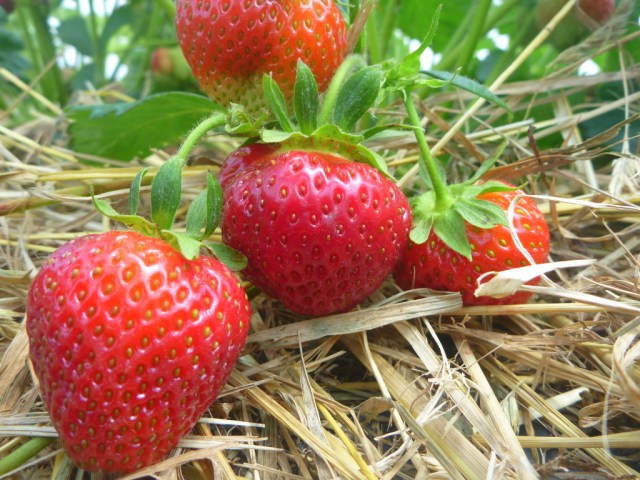
Remember those green strawberries we looked at last week? Now they are red, and ready to meet the ultimate fate of a strawberry.
Nom nom nom!
NOM! NOM! NOM! NOM! NOM!
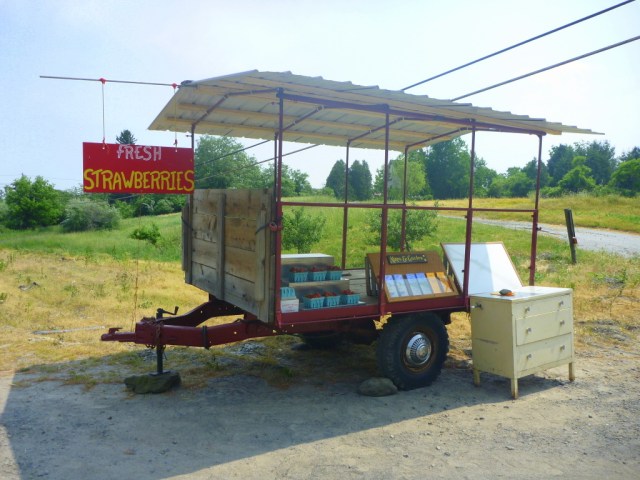
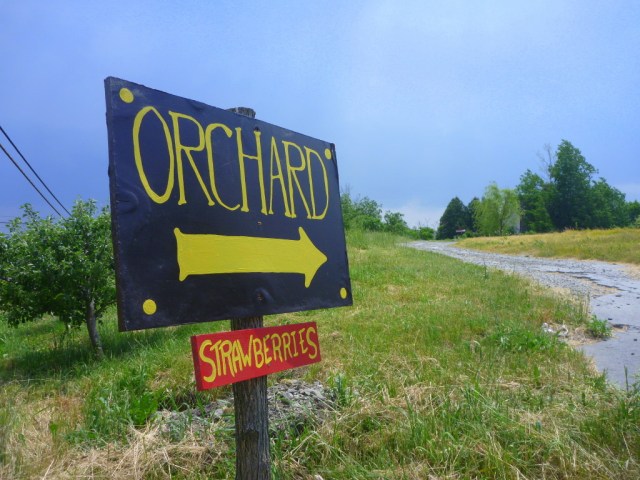
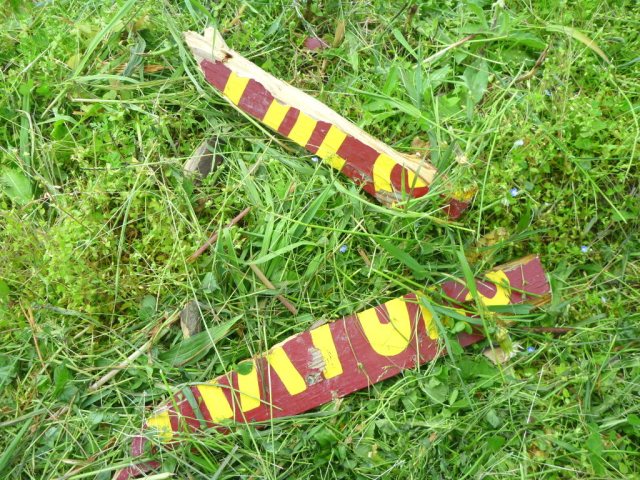
These strapping blokes have installed a sign on Route 96 to remind you that Strawberry Hour has arrived.
You’ll see this rickety little wagon. In 2 minutes flat you can pull off the road, grab a couple quarts of farm-fresh berries, and leave your bills in the slot.
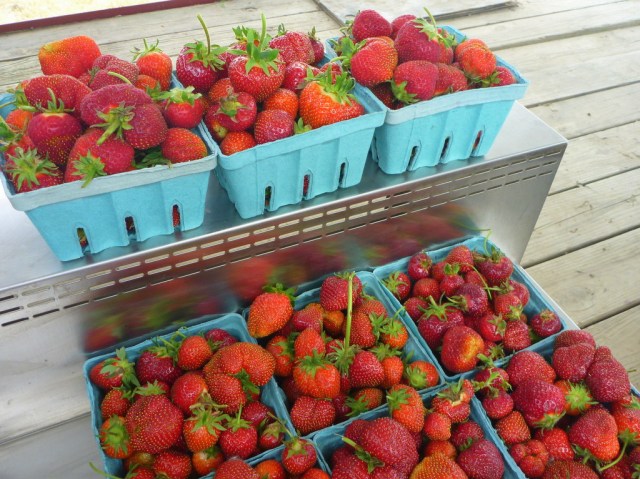
Pick up a quart to drop off at a friend’s house!
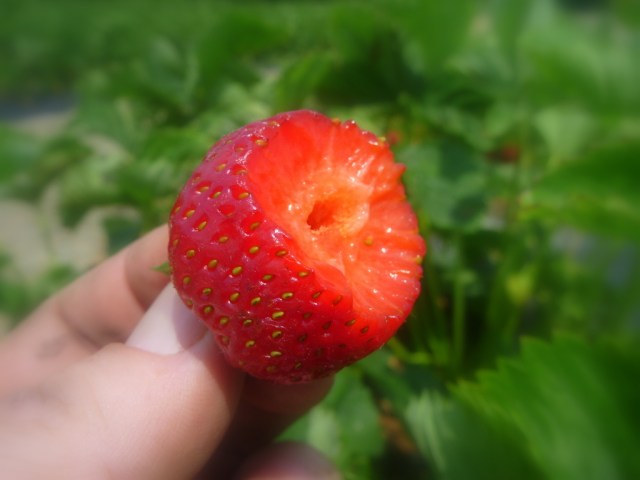
Bursting with juice. Make great smoothies!
Want to hand-pick them yourself? Get your quart boxes at the wagon, then follow the signs to the Berry Patch. Hope to see you soon! Weather has cooled, weekend is here, and berries are waiting.
Hey, y’all. Happy holidays! It’s almost time for a bowl of fresh-picked strawberries! I just went crawling around the strawberry field and found something pretty great…
First strawberries of 2011!
Thousands of these! Bam!
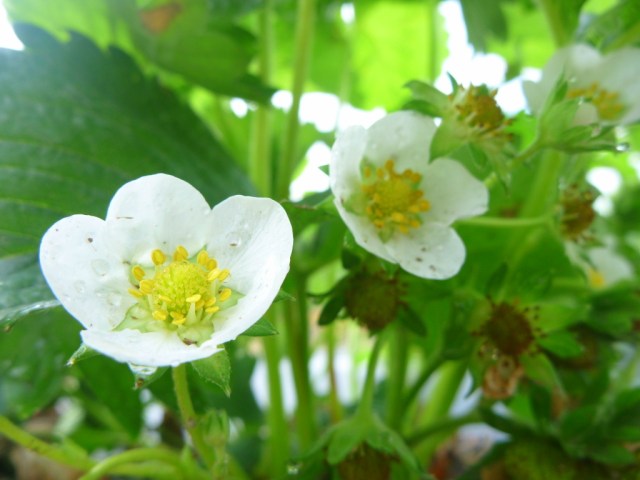
Strawberry blossoms.
Of course some of the berries are still at the blossom stage.
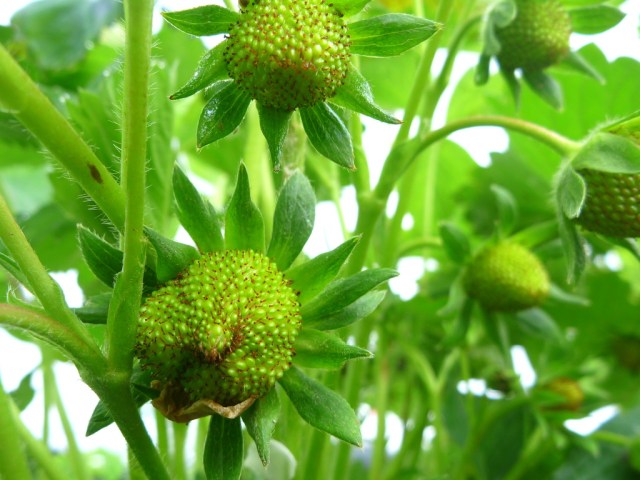
Strawbabies!
And some are in between.
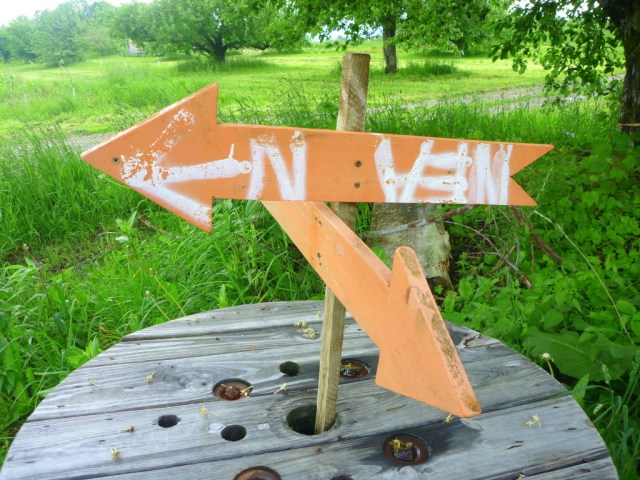
Walk this way.
By mid-June, there should be plump, sweet, juicy strawberries to pick. We’ll straighten out our signs by the time you get here! See you at the farm!
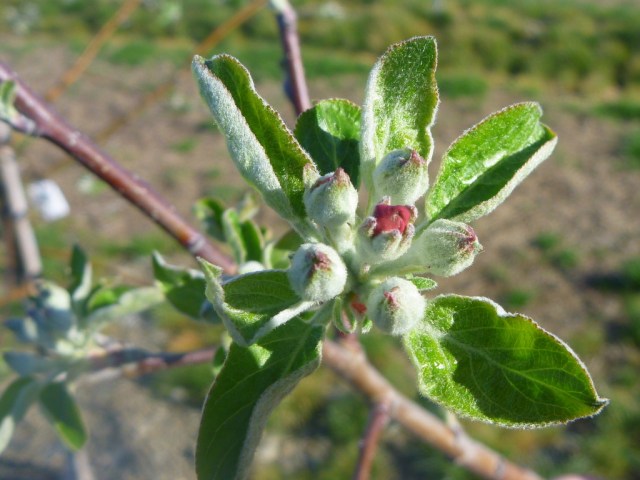
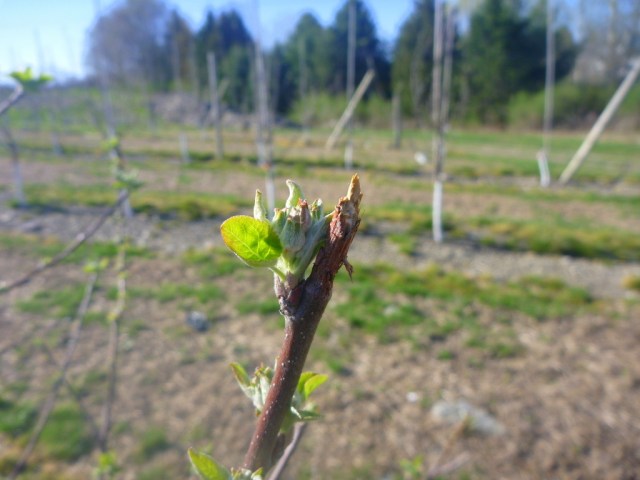
Take 6 divine little apple buds, tenderly formed and full of promise…
6 apple buds.
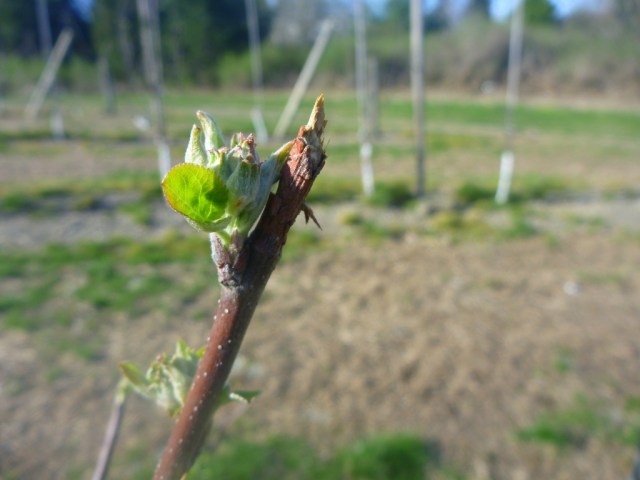
Add 1 chomp by a woodland hoodlum…
Chomped by woodland hoodlum.
And you get zero apples. See, 6 + 1 = 0. Strange but true.
You might remember from Miss Crabapple’s biology class that buds turn into blossoms, and blossoms bring forth fruit. If a branch gets “nipped in the bud,” bye bye fruit pie. Luckily the neighborhood ne’er-do-wells have left plenty of buds, so it won’t be long til we’re sending out fresh crop alerts!
Extra Credit
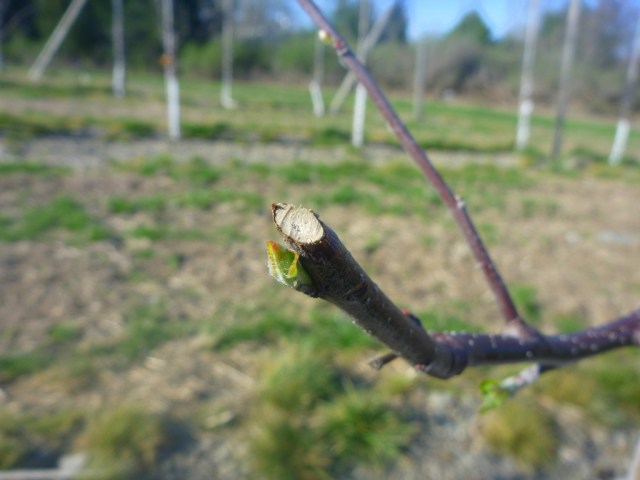
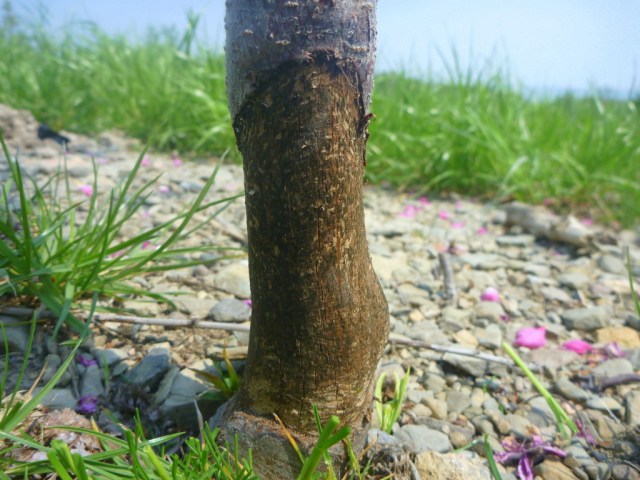
Each of the apple trees below was damaged by a different critter — mouse, rabbit, or deer. Which was which?
1. An impressive clean cut, perfect and planar like a saw blade…
Who did this?
2. Jagged and stringy, as if stripped like honeysuckle…
And who did this?
3. Just plain dead, no nutrients getting through…
And who killed this tree?
(Remember xylem and phloem — more on those another day.)
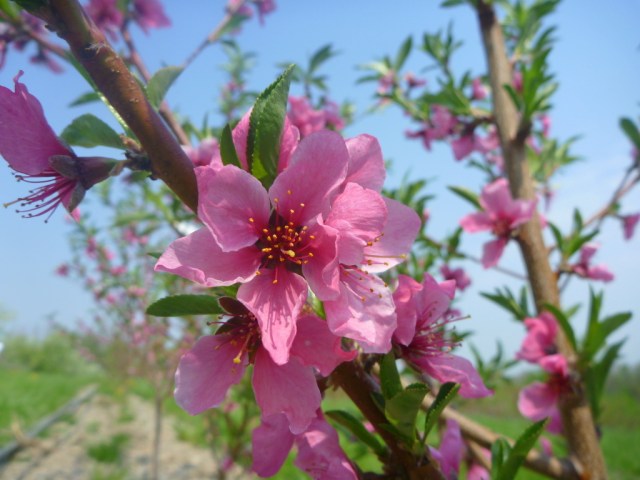
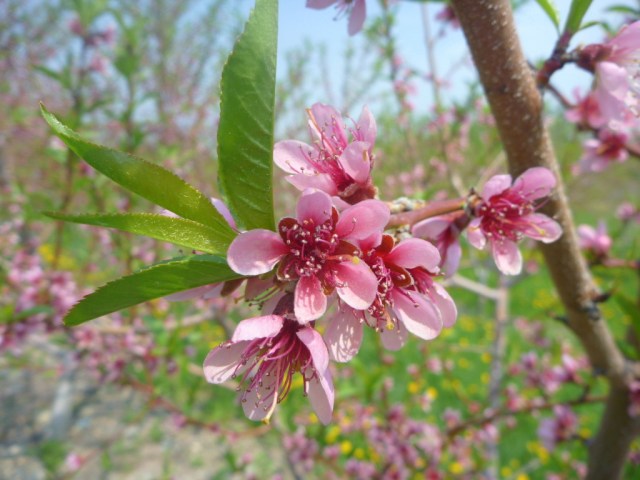
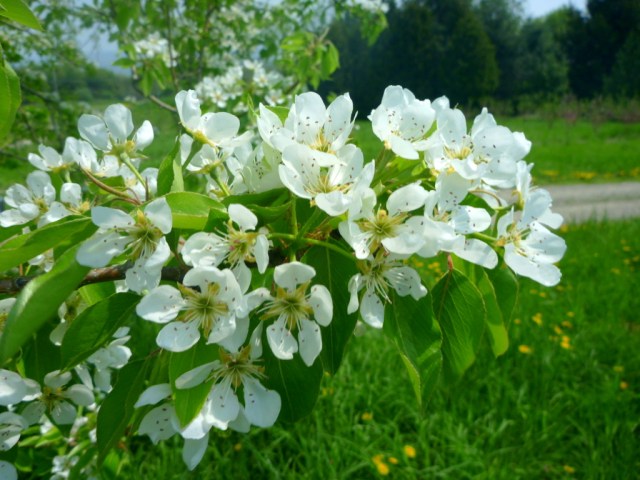
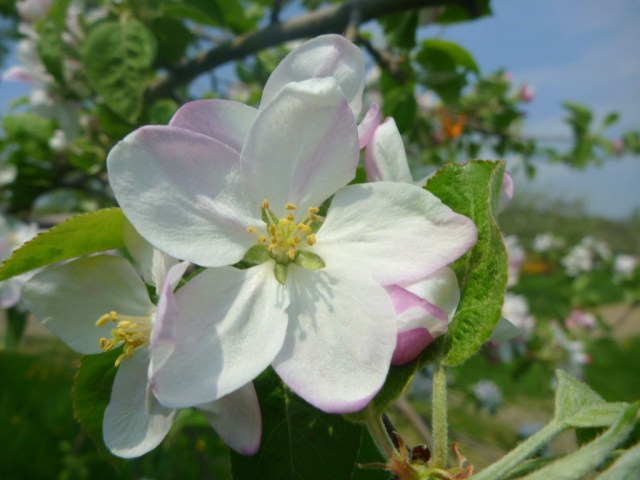
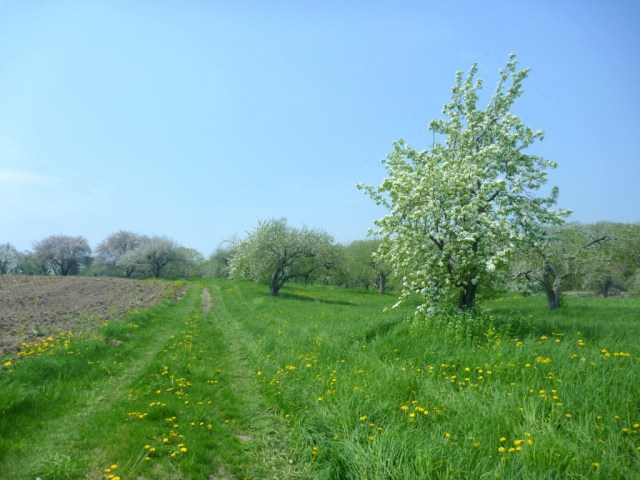
There are a few days in spring when the orchards pop with blossoms. Wind, rain, and biology conspire to make the show short-lived. You have to enjoy the blooms while they last, and get photos on the spot or wait til next year. Had a heck of a time photographing the pear tree in the video; eventually there were still moments and we snapped photos.
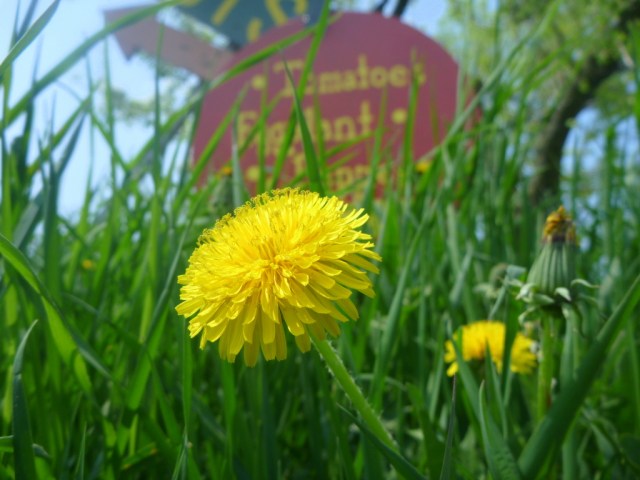
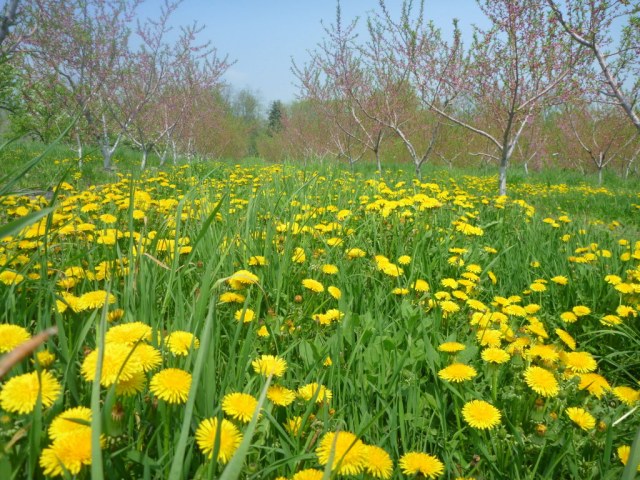
Spring on the farm, before the first mowing. The grass is long, dandelions are tall, and everything waves in the wind. Set the camera in an old apple tree, up in the meadow near Stumphenge.
Now crawling around like a bug. Clickety-clicking the camera.
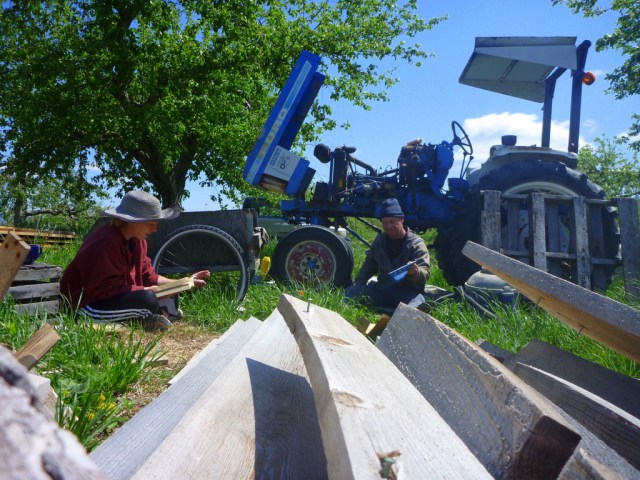
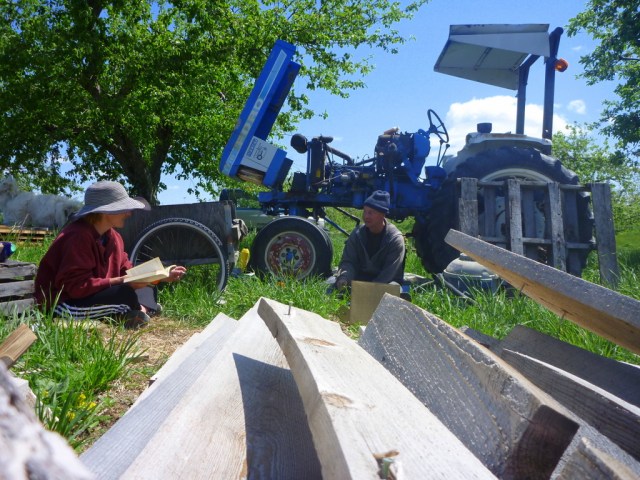
Not least the old Ford tractor, because in a bird-eat-bird world, you don’t thumb your beak at an iron-clad condo with sweeping views. The farm hawk, among other predators, isn’t going to divebomb such a fortress, and the dogs can’t reach high enough to bother.
These downy chicks seemed to be craning their necks in anticipation of afternoon snack. I found the soundless exertion creepy, recalling Edvard Munch’s The Scream, painted in 1893—long before the existential panic called Facebook.
At any rate, birds weren’t the sole squatters at Camp Busted Tractor that day. After a couple hours work we cranked the engine, only to recoil at a CLANG! THWACK! BOOM! (Pause.) CRANGGG!
When the blue smoke cleared, Farmer Stephen scratched his head and I muttered some consolation. Stephen disassembled the manifold to find bits of a peach pit which had been squirreled away—rather, moused away—somewhere inside.
A big shard had been suctioned through the system when we turned the key, which fouled the cylinder and doomed the Blue Ford to a season of rehab. That’s a $1,500 peach pit, if we appraise objects by how much they screw us over.
As for the bird’s nest, I got the feeling that Mama was somewhere watching us anxiously. We left the helpless babes alone because the tractor wasn’t moving after all. Not sure what we would have done otherwise. Do we call the Cornell Lab of Ornithology for instructions?
If, for your evening walk, you should like to pass a few minutes untroubled by world affairs, it is best to avoid an encounter with duct tape. Today I was not so fortunate.
Someone, somewhere, is in a bloody fight for something. It is more or less desperate and bursting with heartbreak. There might be winners, but everyone will lose. Heroes will slaughter heroes. The flickering swath told me so.
Most people, even patriots of Duct Tape Nation, probably find the video a real snooze, but I can watch it looping for a good long time. I think it can hold its own in the genre traditionally headlined by faux fire.
Try running both movies at once. Turn up the volume so you can hear the fire within and the wind without. What is your white noise of choice? Crickets? Rain? Distant weedwackers?
What are tractor weights? They are weights you hang on a tractor. They help balance things out, like ballast in a boat. That’s because a farm tractor is not really rolling through a field; it is floating.
Especially when you are working in spring mud, soaked by the thaw, you are talking about buoyancy as much as traction. Sure, your tires might slip from time to time, spinning as they momentarily lose their grip on the soil, but a decent tractor can generally get enough purchase to go forward. What is not so certain is, are you balanced properly for the project at hand?
When you are working the fields, you have tools—called attachments—hooked up to the tractor. You might drag a plow behind you, for example. As you drive along, your plow is inclined to dive like a submarine, and that will pull the front wheels of the tractor off the ground. You’ll lose your “steerage,” as they say in boating lingo. But if you hang some heavy steel off your front bumper, that will balance you out. You will be able to plow the soil and steer your tractor.
We have another tool, the tree digger, that we use in the nursery. It is kind of clever. Each year we have to dig up thousands of young fruit trees so they can be replanted in orchards and parks. We drive the High-Boy tractor over long rows of trees, bending the trunks but not snapping them, and the digger gently dislodges the trees. Then we collect them by hand, bundle them up, and toss them into the pickup. Beats the old shovel technique, one tree at a time.
If the digger is not weighted, it won’t dive deep enough, and it will break right through the roots of the young trees. That kills them. Instead if you add weights to the digger, you’ll sink the business end deeper into the earth where it will clear the roots. Perfectly executed, the nursery trees get lifted up, roots and all, and topple gently onto the surface without mechanical damage to their roots or bark.
Usually in the form of solid steel plates, tractor weights are expensive to buy, maybe $500 or more to satisfy our requirements on the High-Boy. On this project we took the do-it-yourself route and spent a total of $0. We tinkered for an hour and then made the weights in another hour. In this case the 2-hour timesink was better than the cash outlay.
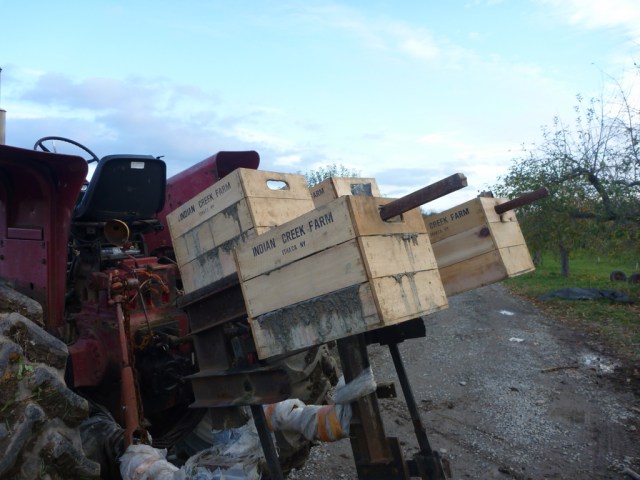
Materials were free because we had them laying around: a bag of concrete mix, wooden apple crates, and scraps of metal. Google provided some ballpark densities for concrete and steel. After an intricate hillbilly calculation scrawled on a 2×4, we estimated that 4 crates, filled to the brim with iron-doped concrete, would achieve our target mass, while retaining the option of removing a crate if we overshot, or if conditions in the field called for different weights on different days. It’s a modular design.
The video above was our test run. There are no trees in that row, but we could see that the digger was diving to a good depth. Next we try it in the nursery.
If they work in the nursery, we won’t feel like geniuses or anything. You could argue that factory-made tractor weights would be superior in a couple ways and you might be right. But the thought of coughing up serious cash for lunks of steel was abhorrent to us at that moment. As we proceeded to stir the wet concrete and cram it full of metal garbage, I had the distinct feeling of being a couple of old moonshiners agitating our sour mash. I kept looking over my shoulder furtively, thinking, Can we do this? Aren’t we supposed to buy the genuine article?
Something drew us inexorably forward and we converted the crates into weights.
















 Indian Creek Farm